

Two years ago, SBHS was at capacity with almost 2,400 students filtering through the front door eager to attend the 112-year-old public school. But when the doors swung open for the 2025-2026 school year, the high school fell short of its projected enrollment by 133 students.
Why the steady decline? It could be due to the passing of Florida HB1, a new law that allows any student, regardless of income level, to take the $8,000 a year of educational funds and go “school” shopping.
The bill essentially allows parents to use tax funded vouchers to pay for their children to attend private school, whether they are economically disadvantaged or not.
The result has been an exodus of money from public schools. Meaning wealthy or well-off parents are taking advantage of these vouchers funded by tax dollars to put their kids into schools they were already able to afford. The Orlando Sentinel revealed an example of this at St. Margaret Mary’s Catholic School in Winter Park. “At this school in…one of Central Florida’s wealthiest communities, about 98 percent of students used taxpayer-funded scholarships worth roughly $8,000 to help pay tuition last year. Only 3% percent of St. Margaret Mary’s students got that state financial aid just one year earlier.”
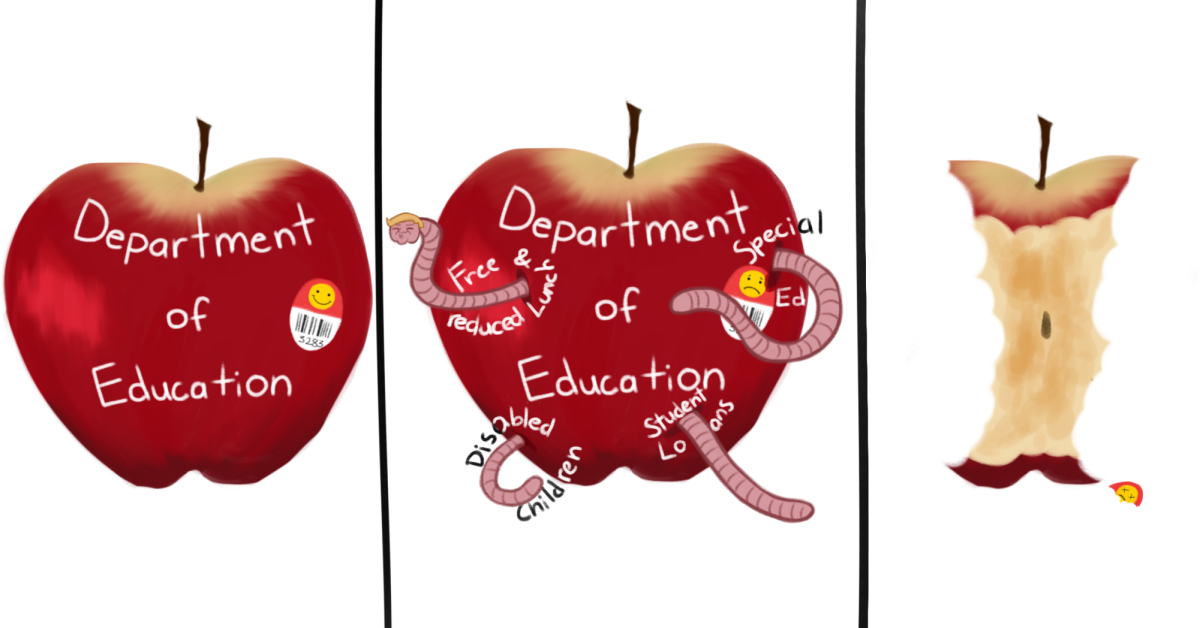
Instead of maximizing funding community public schools, taxpayer funds are going towards the greed of the wealthy. Wealthier families, who already have access to private institutions, now benefit from taxpayer dollars that should be strengthening community schools. They can cover the full cost, but they take vouchers anyway, essentially taking money away from public schools directly. This shift doesn’t create fairness, it creates imbalance. Public schools like South Broward are left cutting tutoring programs and BCPS has to cut free lunches, while private schools expand with state support.
Hixon, a 30-year veteran in the Broward County Public School (BCPS) district, argues that vouchers divert taxpayer dollars to private institutions that have less regulations and guidelines.
This weakens the public system that accepts and serves all children. BCPS receives $4,916 in local funding per student, and $4,070 in state funding per student, meaning in total BCPS receives $8,986 per studentAnd the pinch is already being felt. My high school, South Broward, has had to cut its afterschool tutoring program it had for years due to lack of funding. Teachers now spend personal time after school supervising students that receive service hours for tutoring. Kids in public school are now at a disadvantage because we are being underfunded by the state. It seems like political agenda is superseding our future, and we’re being brushed aside.
“Each year we see more families choosing private options with state-funded vouchers,” she said. “This shift reduces our student count, which directly impacts the amount of funding we receive from the state.” says Hixon
Since Jeb Bush’s governorship over Florida in the late 90s to early 2000s, the Florida republican legislature has beat the drum of “parent choice,” meaning parents could decide for themselves where to send their children to school. Claiming that traditional public schools were failing, Bush excited parents with the prospect of new, enriching schools in the form of charter schools or by providing vouchers to coveted private schools – most of which were religious in nature. According to the parent choice plan, these acts would level the playing field for low-income families.
Although his revamp of schools proved both beneficial and harmful to the state in the long run. Although scores improved statewide, the A+ Plan for Education’s heavy focus on standardized testing has stressful effects still felt by students today. Course curriculum has increasingly been becoming more ridiculous than rigorous. Things are getting more difficult for no apparent reason.
Another consistent downside is that paying for those vouchers directly pulls funds away from the public school system. With HB-1 Governor Ron DeSantis has taken it further, all in an effort to privatize education. My school no longer has enough funding to sponsor afterschool tutoring, and teachers are now forced to give up even more of their private time to keep students on track.
In the past, families had to qualify for the voucher program in order to receive it. The general scholarship was limited to families’ income to between 185%-400% below the federal poverty level ($110,000 for a family of four in 2022) But that is gone. Since House Bill 1 was passed, the program has exploded in popularity. In the 2022-23 school year, 14,520 students used FES vouchers and 10,027 used FTC vouchers. By the 2024-25 school year, that number grew to 36,550 and 14,435 respectively. Wealthier families, who already have access to private institutions, now benefit from taxpayer dollars that should be strengthening community schools. They can cover the full cost, but they take vouchers anyway, essentially taking money away from public schools directly. This shift doesn’t create fairness, it creates imbalance. Public schools like South Broward are left cutting tutoring programs and BCPS has to cut free lunches, while private schools expand with state support.
According to the Florida Policy Institute, the state operates two primary voucher programs. The Florida Empowerment Scholarship (FES) is financed by redirecting state education funds that would otherwise go to public school districts through the state’s funding formula. Meanwhile, the Florida Tax Credit Scholarship (FTC) is supported through tax credits that reduce the amount of money collected in state revenue, effectively diverting taxpayer dollars.
Together, these programs represent a significant shift in how public education resources are allocated, raising ongoing debates about equity, accountability, and the future of school choice in Florida.
According to Florida Policy Institute, the Universal Vouchers are set to cost Florida nearly $4 Billion in the 2024-25 school year and beyond. Over the past decade, Broward County Public Schools’ enrollment has fallen by nearly 40,000 students.
Florida’s vouchers have seriously put the public school system in jeopardy of downsizing. BCPS now faces serious impending problems due to declining enrollment. WLRN reported that 34 Broward County schools are under consideration for repurposing or closure. These closures include “16 elementary schools, 15 middle schools and three high schools…High schools are not on the list of closures, officials said, as they have more than 80% capacity use.
It’s sad to see schools with decades of history be closed or revamped unrecognizably. If more public schools face closure, surrounding public schools and even private schools will see an exponential increase in class size, due to the influx of new students. This would make the problem of overcrowding even worse, and it’d not resolve the worry of parents who choose private schools because of more focused small classes.
With closures and fewer schools, the public schools still left will face double the pressure. More students and less space, due to the new Schools of Hope Law. This law allows charter schools to take residency in public schools without having to pay rent. According to NBC 6 South Florida, “The law mandates that school districts not only allow the charter schools to exist without paying rent, but taxpayers are also responsible for their security, custodial needs, and cafeteria expenses.” This will only squeeze public funds even more.
To help fix this, we, members of the community, can advocate for public education, and show our elected officials we care. We can reach out to members of the school board and make a promise to band together to help return public education to a more solid state.
People in support of vouchers would say it’s a good thing to empower parent choice, and that the vouchers promote competition. These are valid points but pulling extra funding for public schools and allocating it to private and charter schools which usually have extensive non-state funding, makes it difficult to compete. If public schools have to decrease their budget because they receive less state funding, then it’ll be hard for them to make the changes necessary to compete with institutions that can practically receive up to double their funding through state and alternative means.
A study found by PublicSchoolReview, a company that studies school data, revealed that in a 2025 study they found “While private schools often report higher raw test scores, this advantage largely disappears—or reverses—when adjustments are made for demographic differences like socioeconomic status. In effect, students’ backgrounds, not schooling type, are the strongest predictor of performance. “
HB1 is not simply about giving parents more choices—it’s about undermining the foundation of public education. While the idea of “school shopping” sounds appealing, the reality is that universal vouchers drain resources from the very schools that serve the majority of Florida’s children.