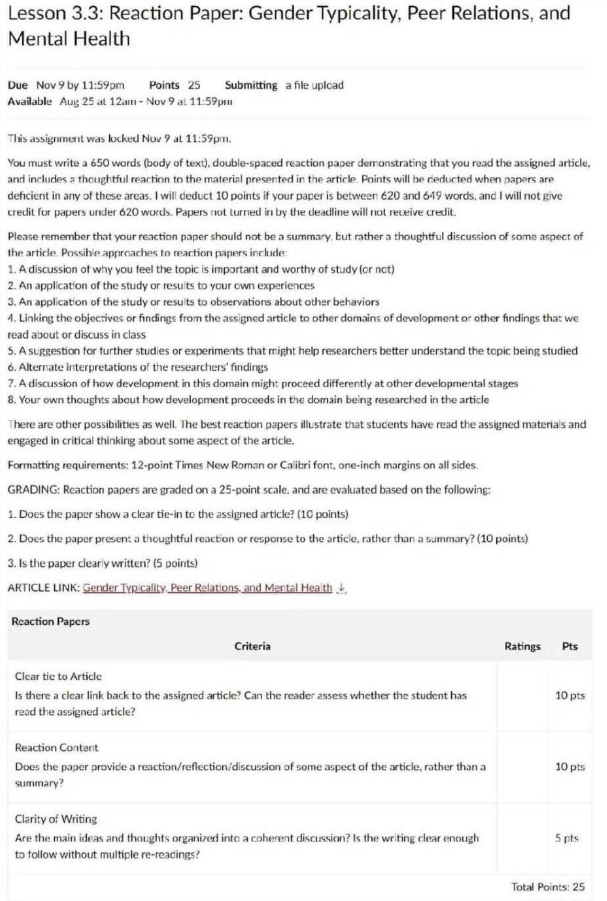


In November of last year, the University of Oklahoma fired a graduate instructor for giving a failing grade to an undergraduate student. In a reaction to a study on middle school gender norms, the undergrad student, Samantha Fulnecky, wrote that gender roles were created by God and the concept of multiple genders was “demonic”. Upon receiving an F, she filed a grade appeal and alerted the right-wing organization Turning Point USA of the incident. A media frenzy ensued, igniting another battle in the culture wars; one side claiming religious discrimination and the other claiming that it was a fair assessment. It culminated in the firing of Mel Curth, an award winning instructor whose transgender identity had faced scrutiny from such groups.
The peer-reviewed study the assignment was based on, “Relations Among Gender Typicality, Peer Relations, and Mental Health During Early Adolescence,” never discussed multiple genders. It surveyed middle school children and found that children who conform to traditional gender stereotypes tended to be more popular and well-liked, while those who do not conform were more likely to experience depressive symptoms. Students were asked to write “a thoughtful reaction to the material presented” and offer points based on the study. Fulnecky wrote that the premise of the article was that there were more than two genders, which frustrated her. It seems to me that Fulnecky ignored the scientific goals of the assignment to make a religious point. Instead of engaging with the data of the study, she wrote, “To claim that there are more than two genders is to claim that God was wrong in His creation of humanity, and that is a dangerous lie to feed our youth.”.
Until this point Fulnecky had gotten good grades in the course. The assignment was worth 25 points, roughly 3% of her final grade and with her supposedly stellar academic record, the assignment wouldn’t have brought her grade down by that much. Multiple other instructors for the course agreed with Curth’s grade and in the end did not face nearly as harsh repercussions as Curth did.
My impression is that Fulnecky’s intention from the start was to get Curth fired. Fulnecky is a member of TPUSA’s UO chapter, a group strongly set in their anti-transgender beliefs. In her essay she discussed her opinion on gender-queerness and her belief that men and women are created by God to be the gender assigned to them at birth, by His design. I doubt she agreed with Curth’s existence as a transgender woman or teacher and saw her grade on this assignment as a means for her dismissal, not for academic justice.
What should have been an internal dispute, settled with an investigation and grade change (if that) was another log on the culture war bonfire. This incident was an ideal way to further TPUSA’s agenda of right wing Christian nationalism. The group advocates for a strict biological definition of gender, supports national bans on gender-affirming healthcare, and is a known coalition partner of Project 2025, the Heritage Foundation’s right-wing manifesto.
Not only that, the group keeps a running list of educators known as the “Professor Watchlist”, that encourages students to report educators who have left leaning politics. Anti-transgender conservatives have campaigned for years to ban transgender people from working as teachers and to ban the teaching of LGBTQ-friendly material in the classroom. Dozens of educators across the country are being fired or disciplined, and the Trump administration has threatened schools and universities with the loss of federal funding if they do not adopt anti-trans policies.
The right is heralding Fulnecky’s story as a prime example of religious discrimination in academic fields. Oklahoma’s governor Republican Kevin Stitt said: “The situation at OU is deeply concerning. I’m calling on the OU regents to review the results of the investigation and ensure other students aren’t unfairly penalized for their beliefs.” I think this is a massive load of rubbish. Fulnecky was in a scientific class, with a scientific assignment, that had a scientific prompt. Most students use a textbook or research journals, or any other academic database, but she used her own ideologies based on her interpretations of Christianity. Her response also diverged from the topic and failed to provide evidence from any biblical text to give it a leg to stand on. She argued that, “God created us [women] with womanly desires… any other identity is a stray from God’s original plan for the family unit.” This might have been somewhat credible as an unrelated argument if the reader had any proof that the Bible said this.
Ultimately, punishing Curth to validate Fulnecky’s claim suggests that religious expression should grant a student immunity from academic rules. Her submission ignored the scientific prompt to focus instead on an unrelated ideological topic. Furthermore, she failed to support her claims with proper evidence, such as specific citations from the Bible. In any science classroom, grades should be based on a student’s ability to follow the rubric rather than their personal beliefs. Educators cannot properly do their job if they are afraid to educate.